Best Time to Visit Reynisfjara in 2026-2027
A season-by-season read on Reynisfjara, from summer puffins and midnight sun to winter northern lights and quieter sand.
 Written with Björn Einarsson, Iceland South Coast tour guide and local specialist
The short answer
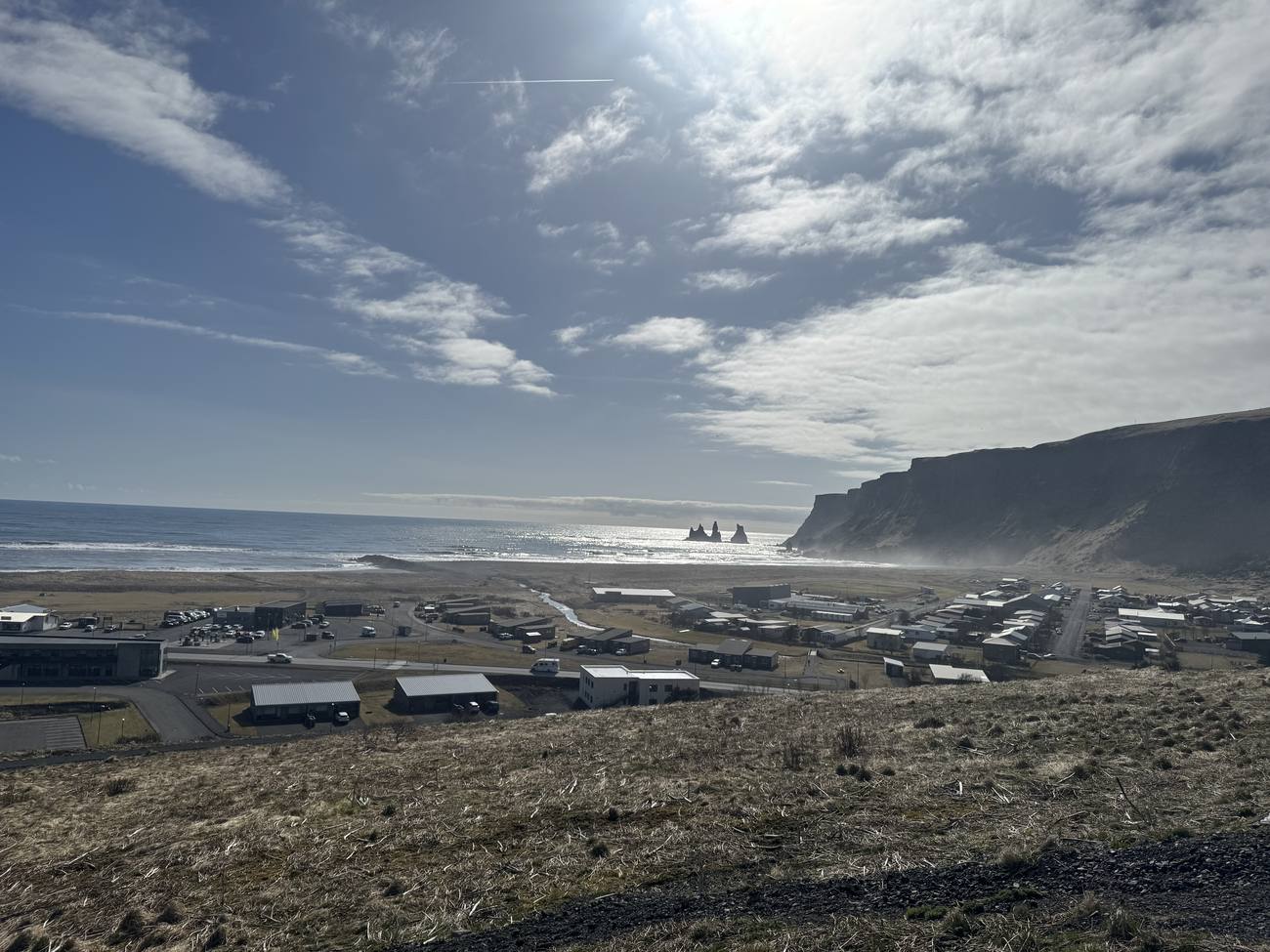
There is no single best time to visit Reynisfjara, only the right time for what you want. Summer (roughly May to August) brings long daylight, the midnight sun and puffins nesting nearby at Dyrhólaey, but also the biggest crowds. Winter offers a chance at the northern lights, dramatic moody skies and far fewer people, at the cost of short daylight and rougher weather. Spring and autumn sit in between with thinner crowds. The coast can be visited in every season, but beach access depends on current warnings and closures.
For a daylight beach visit, the minibus combines Reynisfjara with waterfalls and a glacier viewpoint; an aurora evening is a separate activity. Check your South Coast date
Access update, September 25, 2026: SafeTravel reports viewpoint-only access during current stormy weather and high waves. Follow current warnings and closures; a tour booking does not grant access to restricted beach areas.
Reynisfjara changes character with the seasons more than most beaches, because Iceland's light and weather swing so hard between summer and winter. The same stretch of black sand can sit under a midnight sun that never quite sets or under a low winter sky with a chance of the northern lights overhead. Deciding when to go is really about deciding what you want to see.
Want the beach and waterfalls in your summer or winter itinerary? Explore the 10-hour minibus route from Reykjavík. Explore the South Coast minibus route
Summer: long light and puffins
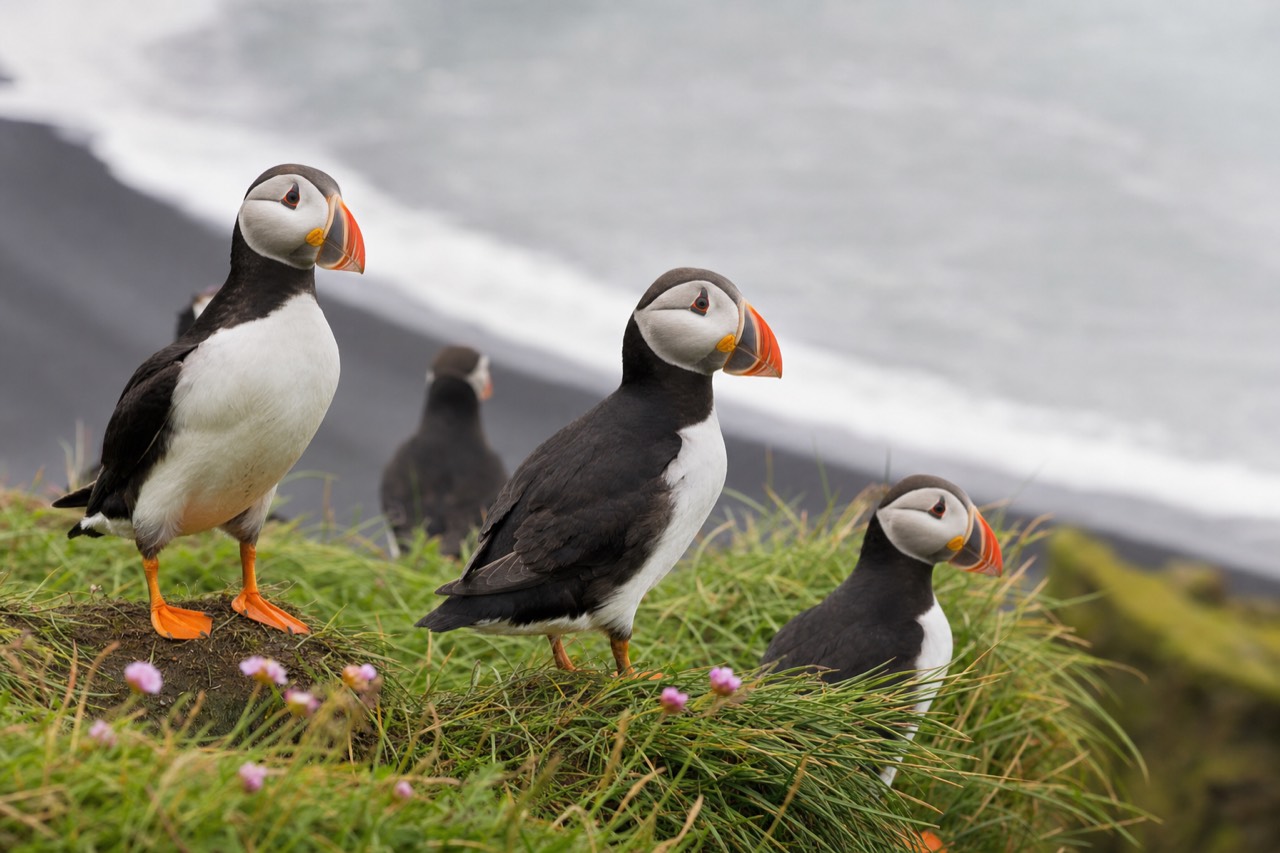
From roughly May to August, the South Coast gets very long days, tipping into the midnight sun around midsummer when the light barely fades. That gives you huge flexibility to visit early or late and dodge the crowds, and it makes the black sand glow under soft, low sun for hours. Summer is also puffin season: the birds nest at nearby Dyrhólaey roughly from May to August, so a summer trip can pair the beach with a puffin viewpoint a short distance away.
The catch is company. Summer is peak season, and Reynisfjara's car park fills with coaches through the middle of the day. You get the best weather odds and the wildlife, but you share the beach with the most people.
Winter: northern lights and empty sand
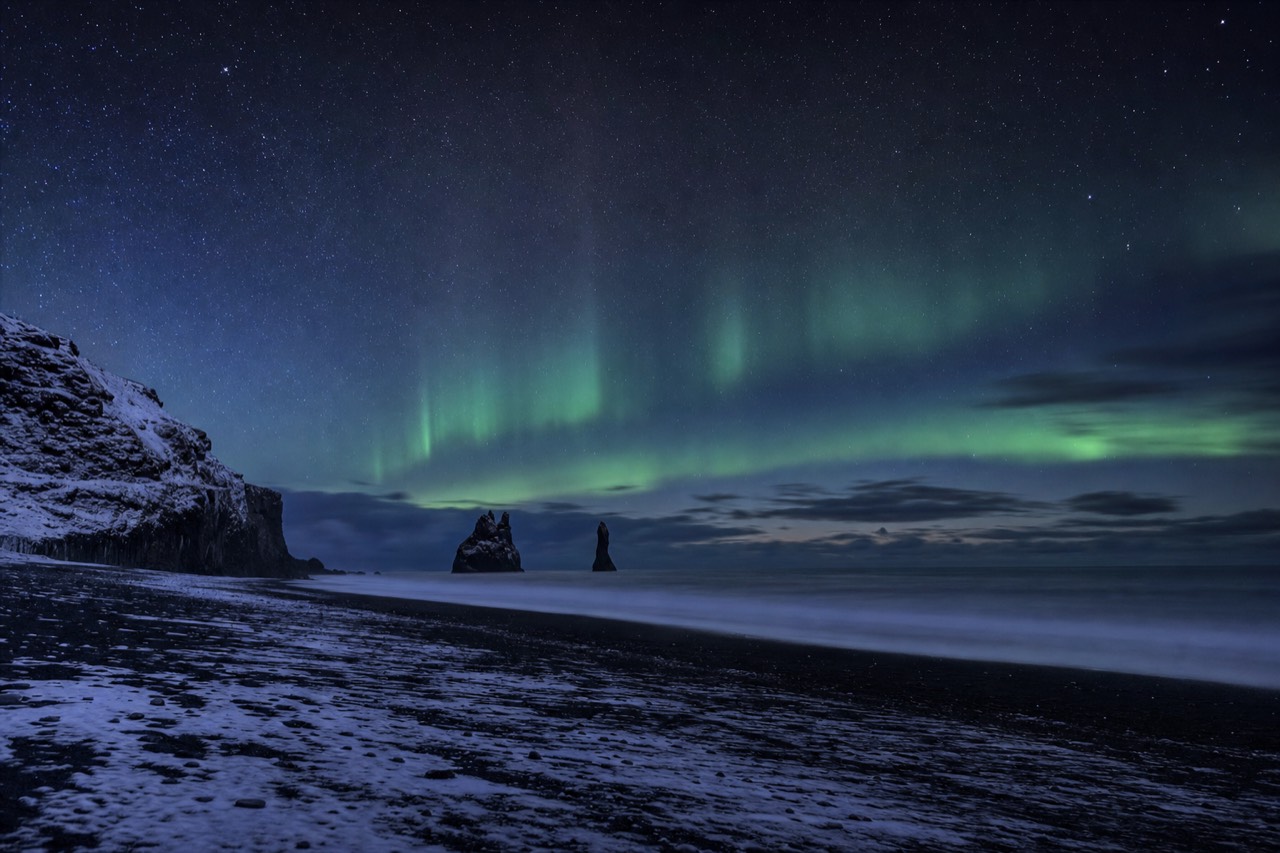
Winter flips everything. Daylight is short, the weather is rougher, and roads can carry snow and ice, so a winter visit needs more planning and flexibility. In return you get moody, dramatic skies, a real chance at the northern lights on clear nights, and a coast that can feel quieter than in July, although beach access can be restricted. For photographers and anyone chasing atmosphere over sunshine, winter Reynisfjara is hard to beat. The aurora, though, is an evening affair and the South Coast day trip runs in daylight, so chasing the lights means a separate evening outing from Reykjavik.
Just respect the season. The same storms that reshaped the beach in early 2026 are a winter phenomenon, and the sea is at its most violent when the weather is wild.
| Season | Daylight | Highlights | Crowds |
|---|---|---|---|
| Summer (May to Aug) | Very long, midnight sun | Puffins at Dyrhólaey, soft light | Busiest |
| Autumn (Sep to Oct) | Shortening | Fewer people, early aurora chances | Moderate |
| Winter (Nov to Mar) | Short | Northern lights, dramatic skies, empty sand | Quietest |
| Spring (Apr to May) | Lengthening | Thinner crowds, puffins arriving | Moderate |
Shoulder seasons: the quiet sweet spot
Spring and autumn are the underrated picks. Crowds thin out, prices and pressure ease, and you still get workable daylight without the deepest winter dark. Late spring starts to bring the puffins back to Dyrhólaey, while early autumn opens the first realistic northern-lights chances as the nights lengthen. If your priority is seeing Reynisfjara without a wall of coaches, these months reward you.
Time of day matters too
Whatever the season, the hour you arrive shapes the visit as much as the month. Early morning and late afternoon are quieter and light the black sand and sea stacks more kindly than harsh midday sun. If you are travelling in summer, use the long daylight to visit outside the mid-morning to early-afternoon coach rush.
A guided day trip can handle the transport, but its departure, route and permitted stops still depend on conditions. Check the operator’s cancellation deadline before booking, especially when winter weather could alter your plans.
Reynisfjara’s scenery changes with every season, and access depends on current conditions. Pick summer for daylight and puffins, winter for aurora and solitude, and the shoulders for the quiet middle ground.
Season by season: what changes at the beach itself
At a glance: summer brings the midnight sun and puffins nesting nearby at Dyrholaey, autumn brings thinning crowds and the first aurora chances, winter brings northern lights and a real chance of storm-driven erosion risk, and spring brings lengthening days with puffins returning, with access depending on current conditions. None of this is new information on this page, it is what is already established above, pulled into one table so you can compare seasons side by side.
| Season | Light | What's happening at the beach | Wildlife | Weather risk |
|---|---|---|---|---|
| Summer (May-Aug) | Midnight sun, very long days | Busiest, softest light | Puffins at nearby Dyrholaey | Lowest |
| Autumn (Sep-Oct) | Shortening days | Thinning crowds | Puffins departing | Rising |
| Winter (Nov-Mar) | Short days | Quietest, northern lights possible | None | Highest, storms and erosion risk |
| Spring (Apr-May) | Lengthening days | Thinning crowds, sand slowly rebuilding | Puffins arriving | Moderate |
Nothing in this table is a reason to skip a season. It is a way to match the trip you actually want, whether that is puffins and long light or aurora and empty sand, to the month you book.
Should you chase the northern lights on the same trip?
You can, but it takes a second, separate booking: the South Coast day tour that stops at Reynisfjara runs in daylight, so seeing the beach and chasing the aurora on the same trip means pairing that day tour with a dedicated evening Northern Lights tour from Reykjavik, and even then no sighting is ever guaranteed. Clear skies, darkness, and solar activity all have to line up, which is why any honest aurora tour, this one included, sells the chance to look rather than a promise of lights.
The two experiences are built for different times of day on purpose. The day tour is designed to fit Reynisfjara, the waterfalls, and the glacier viewpoint into daylight hours, while an aurora hunt only works once it is properly dark, which in Iceland's winter can mean a late evening departure. Pairing them across the same trip, a South Coast day followed by an evening aurora outing on a different night, is the realistic way to try for both rather than squeezing them into one exhausting day.
| South Coast day tour | Northern Lights tour | |
|---|---|---|
| Time of day | Daytime | Evening |
| What you see | Reynisfjara, waterfalls, glacier viewpoint | Aurora, when conditions allow |
| Guarantee | Planned stops, subject to conditions | No aurora sighting is ever guaranteed |
| Booking | Separate ticket | Separate ticket |
Is winter worth the extra planning?
Winter trades convenience for atmosphere: you get thinner crowds and a real shot at the northern lights, against short daylight and rougher Route 1 conditions, and a guided coach tour takes the driving off your hands, while weather and road hazards still require flexibility. Neither season is objectively better. The trade is real and worth being honest about before you book.
The case for winter is strongest if solitude and aurora chances matter more to you than long golden-hour light or puffins. Winter light gives the coast a different atmosphere from summer; enjoy it only from areas open to visitors. The case against it is equally real: daylight is short, the roads can carry snow, ice, or crosswinds, and self-driving in those conditions raises the stakes of a South Coast day considerably.
| Traveller type | Winter | Summer |
|---|---|---|
| Chasing the northern lights | Best season | Not possible, too much daylight |
| Wants puffins | Not present | Best season (May-Aug) |
| Wants fewest crowds | Best season | Busiest season |
| Nervous about self-driving in snow or ice | Best on a guided tour | Self-drive-friendly |
A guided tour narrows that gap in the most useful way, since someone else is watching the road and the forecast rather than you. It does not manufacture an aurora sighting or extend the daylight, but it means you do not have to drive those winter roads yourself.
How Bjorn calls a weather day
Before a South Coast run, Bjorn is watching three things: wind speed and direction, whether any stretch of Route 1 has weather-related closures or restrictions, and the current warnings and access instructions at Reynisfjara itself, and any one of the three can change the plan for the day. This is the practical, unglamorous side of guiding the same route since 2022: reading conditions rather than guessing.
Wind matters because it affects both driving safety on exposed stretches of road and how the sea behaves at Reynisfjara, where rougher conditions push the sneaker-wave risk higher. Road status matters because Route 1 can close or slow in poor winter weather, changing timing for the whole day. Current beach warnings and closures matter directly on arrival. Follow the posted instructions and stay well away from the ocean; no warning level makes approaching the water safe.
None of this is guesswork dressed up as expertise. It is the same three checks, done consistently, that let a guide make a sound call before a coach full of visitors ever leaves Reykjavik.
How does the time of year change the drive itself, not just the beach?
The season shapes Route 1 nearly as much as it shapes the beach itself: summer's long daylight gives a self-driver huge flexibility and forgiving conditions, while winter can bring snow, ice, and crosswinds to the same stretch of road, on top of the storm and erosion risk already reshaping the coastline through 2026. Choosing when to visit Reynisfjara is really two decisions at once: what you want to see at the beach, and what kind of drive you are willing to take to get there.
Summer keeps the drive simple. Route 1 is paved and well maintained the entire way, and the long daylight around the midsummer months means there is effectively more flexibility in choosing driving times. A late start barely costs you anything when the sun is up for the better part of twenty hours, and the biggest planning question becomes crowd timing at the stops themselves rather than the driving.
Winter changes the equation in a way that goes beyond just being colder. Daylight shrinks to a narrow window, which compresses an already full South Coast day into a tighter schedule than the same route takes in July. Snow, ice, and crosswinds can appear on exposed sections, and the same storms capable of high wind and rough seas at Reynisfjara, the kind already established elsewhere on this site as part of what reshaped the beach in early 2026, are a winter phenomenon on the road as much as on the sand. A guided coach tour handles the driving, but remains subject to the same weather and road restrictions, which is a meaningful part of why winter visitors lean toward a tour over a rental car.
Spring and autumn sit in the middle, closer to summer's ease early and late in each season, and closer to winter's caution at their edges. Neither extreme applies for most of the shoulder months, which is part of what makes them a comfortable, lower-stress time to drive the South Coast independently.
Packing for the drive and packing for the beach turn out to be nearly the same list, since you are exposed to the same coastal weather whether you are behind the wheel or walking the sand.
| Season | What to pack |
|---|---|
| Summer (May-Aug) | Layers for coastal wind, sunglasses, a light waterproof, sturdy shoes for uneven sand |
| Autumn (Sep-Oct) | Warmer layers, a proper waterproof jacket, sturdy footwear with grip |
| Winter (Nov-Mar) | Full winter layers, a windproof and waterproof outer shell, gloves, a hat, boots built for ice |
| Spring (Apr-May) | Layers for changeable weather, a waterproof jacket, a warm base layer underneath |
Matching the month to what you actually want out of the day is a more useful question than chasing a single "best" time, and it is worth being specific about your priority rather than the season alone.
| Priority | Best time to visit |
|---|---|
| Photography | Shoulder season light, or golden hour in almost any month |
| Wildlife (puffins) | May through August, at nearby Dyrholaey |
| Northern lights | Late autumn through winter, on clear, dark nights |
| Fewest crowds | Winter, or the early and late edges of the shoulder months |
| Easiest driving | Summer, when daylight is longest and conditions are calmest |
None of these tables replace checking conditions on the actual day you travel. They are a starting point for matching the trip you want to the season most likely to deliver it, not a guarantee that any single month behaves exactly as described.
It is worth being honest about how differently the same road can behave depending on what week you happen to be reading this. Two visitors travelling in the same month, one at the start and one at the end, can meet noticeably different conditions on Route 1, especially in the shoulder seasons when the weather is still finding its footing between summer calm and winter storms. Treat any seasonal table, including the ones on this page, as a general guide to what is typical rather than a forecast for your specific date.
This is also where the choice between self-driving and a guided day tour intersects with the season question rather than sitting apart from it. A confident self-driver visiting in July is taking on very little extra risk by choosing that route over a tour, since the road, the daylight, and the weather are all working in their favour. The same self-driver visiting in January is taking on meaningfully more, not because the destination changes, but because the drive itself becomes the harder half of the day. A guided tour takes the driving off your hands across the calendar, which is part of why it stays the most popular way to see Reynisfjara regardless of season, even though the beach itself rewards a visit at any time of year.
Thinking about the season and the journey together, rather than the beach in isolation, tends to produce a better trip than picking a month purely because it sounds appealing. The best time of year to see puffins is not automatically the best time of year for you personally, if getting there comfortably matters just as much as what is waiting at the end of the drive.
A useful way to settle on a month, in practice, is to rank your own priorities before you look at a calendar at all. Someone chasing puffins and soft evening light has a fairly narrow window that points straight at summer, with the crowds simply being a cost of admission. Someone chasing solitude and a shot at the aurora is pointed just as clearly toward winter, with the driving conditions being the cost on that side of the ledger instead. Very few visitors are actually torn between the two once the priority is named honestly, which is the real value of working through it this way rather than searching for a single universal answer.
It also helps to remember that "worst" conditions on this coastline are relative, not absolute. A quieter winter weekday with clear skies can be a genuinely easier, calmer visit than a crowded summer afternoon spent circling a full car park, even though one sits in the season labelled as harder on paper. Averages describe a typical month, not the specific day you end up travelling, which is exactly why checking current conditions close to your actual date still matters more than any seasonal generalisation, including the ones on this page.
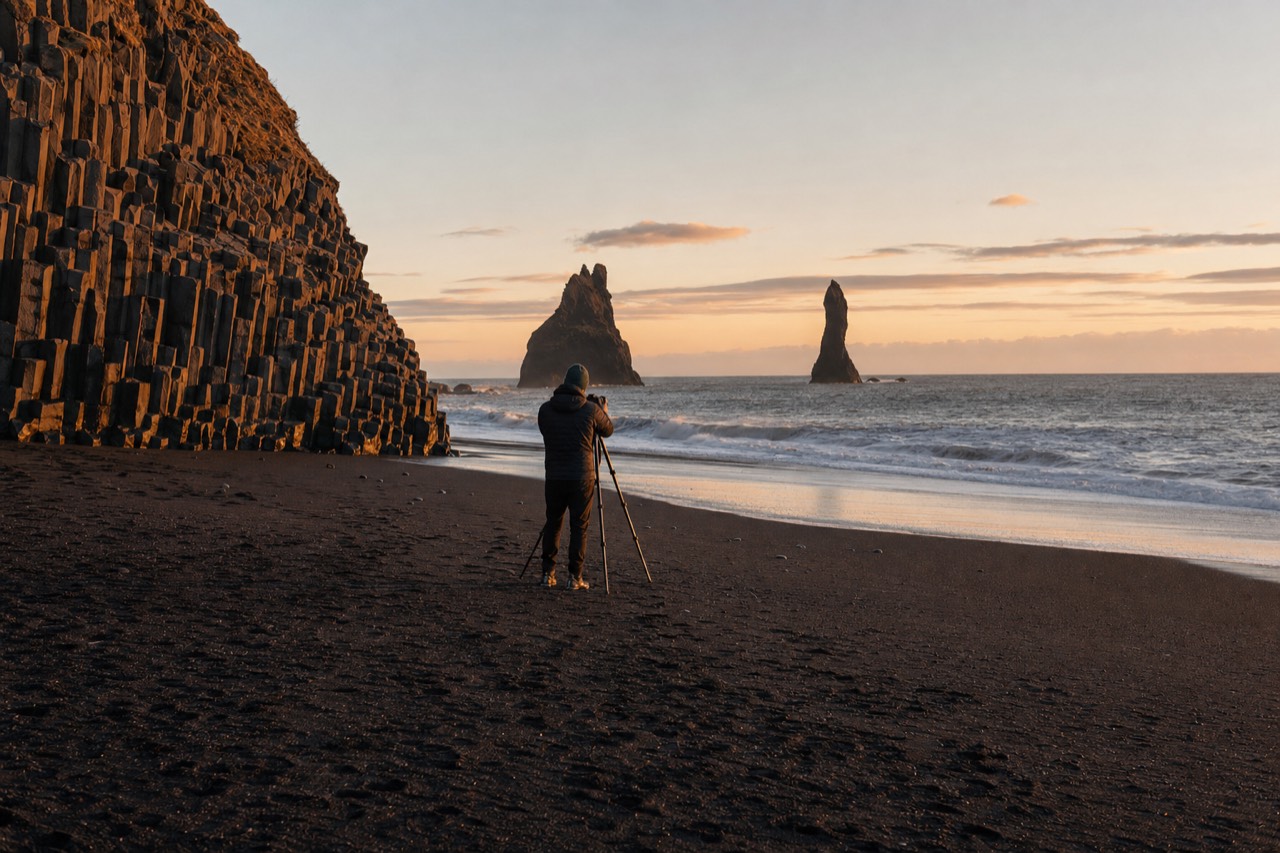
Whatever month ends up on the itinerary, the beach itself does not really change its fundamental character between seasons, only its mood. The sea stacks stand the same height in January as in July, the basalt columns hold their shape year round, and the sound of the surf against black sand is the same drama whether it is lit by midnight sun or framed by aurora overhead. The season decides what else comes with that view, not whether the view itself is worth the drive, and that is as true for a first visit as it is for anyone coming back for a second look.
Common questions
What is the best month to visit Reynisfjara?
It depends on what you want. June to August brings long daylight, the midnight sun and puffins nearby but the biggest crowds. November to March offers northern lights and near-empty sand with short daylight. Spring and autumn are the quiet middle ground. The coast can be visited in every season, but beach access depends on current warnings and closures.
Can you see puffins at Reynisfjara?
Puffins nest nearby at Dyrhólaey, a short distance from Reynisfjara, roughly from May to August. A summer visit can pair the black sand beach with a puffin viewpoint. Outside those months the puffins are out at sea, so time a summer trip if the birds are a priority.
Can you see the northern lights at Reynisfjara?
Yes, in the darker months. From roughly late autumn through winter, clear nights on the South Coast can bring the northern lights, and Reynisfjara's dark, open setting suits them. You need darkness, clear skies and a bit of luck, so winter offers the best chance.
Is Reynisfjara worth visiting in winter?
Yes. Winter brings dramatic skies, a chance at the northern lights and a beach far quieter than summer. The trade-offs are short daylight and rougher weather, so allow flexibility and consider a guided tour that handles the driving and conditions for you.
Choose Your Visit
Initial editorial recommendation. Check pickup and all operator requirements before booking.
Compare Options And Adjust Your Plan
- Iceland's South Coast Full Day Small-Group Tour from Reykjavik: Visit the South Coast waterfalls and the Reynisfjara area in a group of up to 18. 10 hours. Departs from and returns to Reykjavík. Follow current closures: sand, columns and cave access are not guaranteed. Confirm your pickup point.
- South Coast Day Tour Black Sand Beach & Waterfalls from Reykjavik: Combine the South Coast waterfalls and the Reynisfjara area on a shared coach itinerary. 10 hours. Departs from and returns to Reykjavík. Follow current closures: sand, columns and cave access are not guaranteed. Confirm your pickup point.
Iceland's South Coast Full Day Small-Group Tour from Reykjavik
Have a month in mind? Check your actual South Coast date before arranging other day trips, with Reykjavík pickup and a Reynisfjara stop on this route.
10 hours. Departs from and returns to Reykjavík. Guide; Minibus transport; Reykjavík pickup. Meals and drinks cost extra.
Follow current closures: sand, columns and cave access are not guaranteed. Confirm your pickup point.
Choose your date on Viator while the schedule loads.
Scheduled departures only. Availability and final price are confirmed on Viator.